

Ecommerce measurement in 2026 is no longer about whether a pixel is installed. It is about whether the events reaching an ad platform are complete, correctly attributed, and usable for optimization. The ecommerce measurement landscape is defined by signal loss: privacy controls, browser restrictions, consent choices, ad blockers, cross-device journeys, and increasingly fragmented checkout flows.
For PrestaShop merchants running TikTok Ads, the practical consequence is simple. A campaign can generate real orders while TikTok reports too few purchases, assigns weak event quality, or optimizes toward less valuable actions. Repairing this gap requires a shift from browser-only tracking to a deliberately designed hybrid measurement architecture.
Why browser-only measurement keeps losing signal

The traditional TikTok Pixel runs in the shopper’s browser. It can observe pages, product interactions, cart activity, and—in an ideal flow—the completed order confirmation page. This remains important, but it is no longer sufficient as the sole measurement source.
Browser events can be prevented or degraded when shoppers reject non-essential cookies, use content blockers, browse in privacy-focused environments, or move from one browser or device to another. Mobile operating-system privacy policies, including iOS App Tracking Transparency (ATT), also reduce the amount of deterministic information available for advertising attribution and audience building.
These controls do not mean all browser tracking disappears. They mean the signal is uneven. Some visitors produce rich client-side event streams, while others produce partial or no measurable activity. When optimization depends only on those observable visitors, platform reporting and delivery models may not represent the store’s actual customer base.
Checkout gaps are where revenue data most often breaks

The purchase event is the most commercially important event in the funnel—and usually the most fragile. A browser pixel expects to execute after an order is confirmed. That assumption fails in several common situations:
- Payment redirects send the shopper to a bank, wallet, or third-party provider before returning to the shop.
- The shopper closes the tab after successful payment and never loads the order confirmation page.
- A payment module renders a non-standard success flow that does not contain the expected tracking code.
- Consent or browser restrictions stop the final browser request, even though PrestaShop has already created a valid order.
In each case, the ecommerce platform knows the transaction happened, but TikTok may not receive a reliable Purchase event. The result is underreported revenue, a lower apparent return on ad spend, and weaker purchase-based optimization.
Product-level data can fail too. Events without consistent content_id, content_name, value, and currency parameters make it harder to reconcile catalog activity, calculate revenue accurately, and train optimization models on the products customers actually viewed or bought.
The server-side paradigm shift: hybrid, not replacement

Server-side measurement sends events from the ecommerce application or a trusted server environment to TikTok’s Events API. Because the event originates from the store’s transaction logic rather than solely from page JavaScript, it can report key commercial actions even when a browser callback is unavailable.
This is especially valuable for purchases. A server-side event can be triggered when PrestaShop records or confirms the order, using authoritative order totals, currency, product lines, and identifiers. It reduces dependence on whether a thank-you page was viewed.
However, server-side tracking should not be treated as a reason to remove the browser pixel. Browser events still provide useful real-time on-page behavior and platform matching signals. The more robust design is hybrid: send browser Pixel events and corresponding server-side Events API events where appropriate, then deduplicate them correctly.
Deduplication is essential. If both channels describe the same AddToCart or Purchase but use unrelated IDs, TikTok can count two conversions. A shared, stable event_id lets the platform recognize those records as one event received through two channels. This protects conversion totals while preserving resilience.
How to diagnose it

Start by comparing three sources over the same date range: PrestaShop paid orders, TikTok Ads reported purchases, and TikTok Events Manager event activity. Small differences are normal because attribution windows and order-status rules differ; large or sudden gaps deserve investigation.
Then test the complete journey yourself: product page, cart, checkout, payment, and confirmation. Use TikTok’s event diagnostics or a browser debugger to verify PageView, ViewContent, AddToCart, InitiateCheckout, and Purchase. Inspect event payloads for product IDs, names, value, currency, and event_id.
Finally, test payment methods separately. A purchase event that works for card payments may fail after a redirect-based wallet or local payment flow. Check whether browser and server records share the same event_id rather than appearing as duplicate purchases.
How Pixel Track TikTok solves it
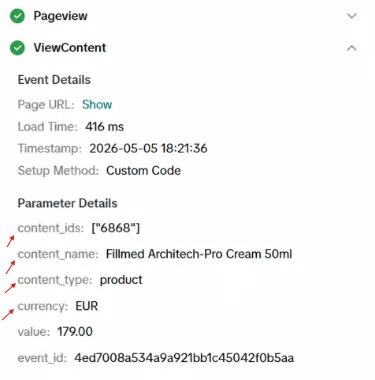
Pixel Track TikTok is designed for this hybrid requirement in PrestaShop 1.7 through 8.2. It sends TikTok browser Pixel and server-side Events API signals with a shared, consistent event_id for deduplication.
The module tracks the core ecommerce funnel: PageView, ViewContent, AddToCart, InitiateCheckout, and Purchase. It includes the parameters TikTok needs to interpret commercial activity accurately: content_id, content_name, value, currency, and event_id.
Most importantly, server-side purchase tracking connects conversion reporting to the store’s order data rather than relying only on a customer reaching a final page in the browser. That makes measurement more durable through redirect-heavy checkout flows and normal browser-side signal loss. For PPC teams, the outcome is a cleaner conversion foundation: browser context where available, server confirmation where needed, and one deduplicated view of each meaningful ecommerce action.
Building a measurement strategy that survives 2026

No implementation can restore every signal removed by privacy choices or attribution limits. The goal is not perfect one-to-one visibility; it is dependable, correctly structured data that reflects actual commerce as closely as possible.
Audit checkout events, standardize product parameters, use hybrid delivery, and validate deduplication after every major theme, checkout, or payment-module change. In the 2026 ecommerce measurement landscape, the stores that protect their first-party transaction signal are better positioned to evaluate TikTok Ads and optimize against real revenue.