

European PrestaShop merchants face a real attribution trade-off: cookie banners can reduce observable conversions, but sending TikTok Events API data regardless of consent creates severe compliance risks. The true objective is not to bypass privacy rules with server-side events, but to preserve high-quality, permissioned signals for visitors who opt in (see our guide to optimize TikTok Event Match Quality scores to make every allowed conversion count).
The most critical misconception is that server-side TikTok tracking is automatically exempt from GDPR or ePrivacy rules. It is not. If an event payload contains identifiers like IP address, ttclid, external IDs, or hashed contact data for advertising attribution or retargeting, the processing still requires explicit prior marketing consent.
Consent Mode v2 does not automatically govern TikTok
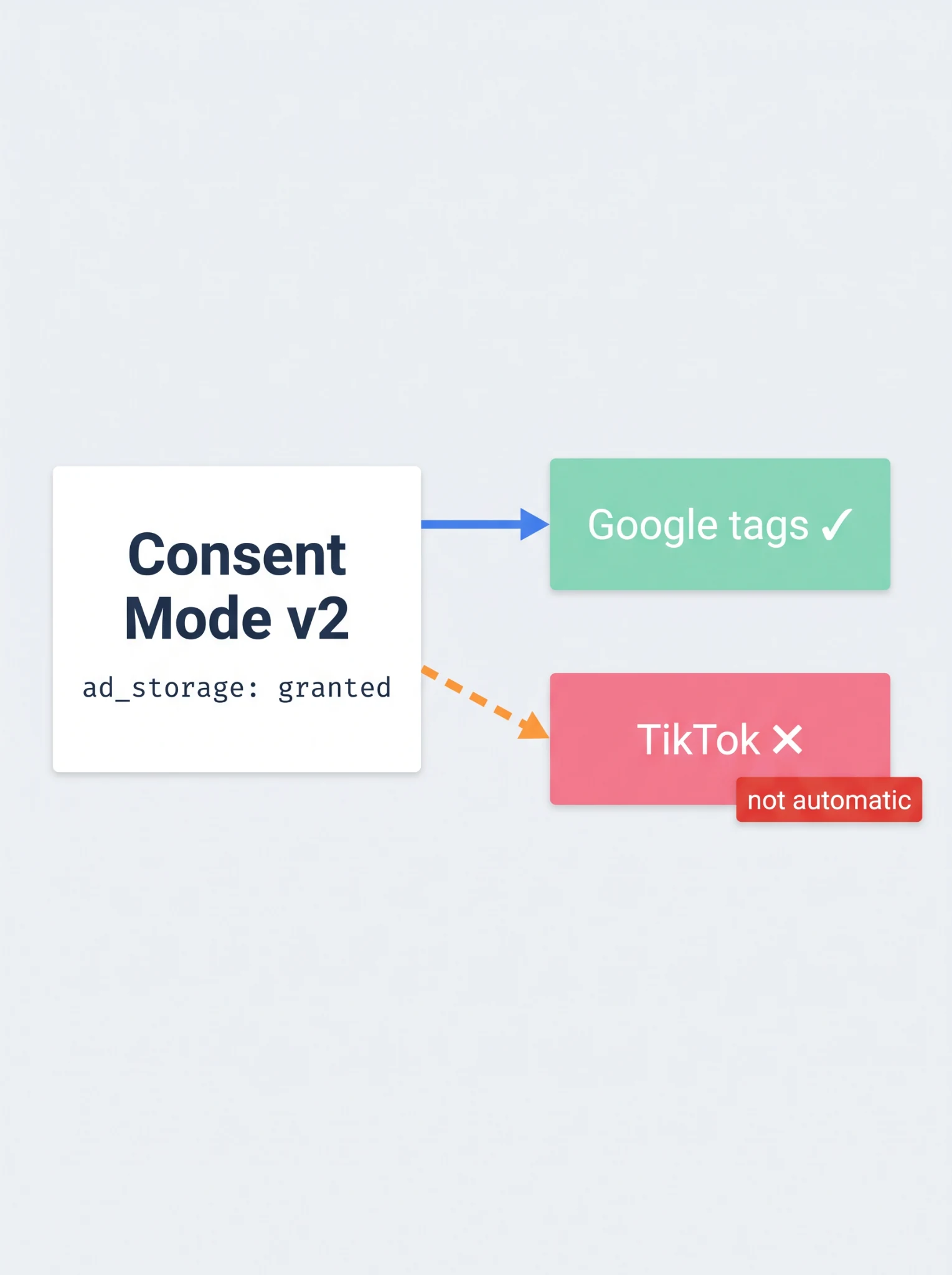
Consent Mode v2 is a Google-specific consent signaling framework. Its ad_storage and analytics_storage states instruct Google tags on how to alter behavior based on the CMP decision; TikTok does not automatically receive or enforce Google Consent Mode signals simply because they exist in the page data layer.
A compliant PrestaShop implementation must explicitly map the CMP’s decision across both tracking layers:
- Browser-side TikTok Pixel: block pixel execution completely until active marketing consent is granted.
- Server-side TikTok Events API: pass the verified consent state to the PrestaShop backend to conditionally control payload dispatching, IP address stripping, or full event suppression.
The architecture that prevents both compliance leakage and signal blackout
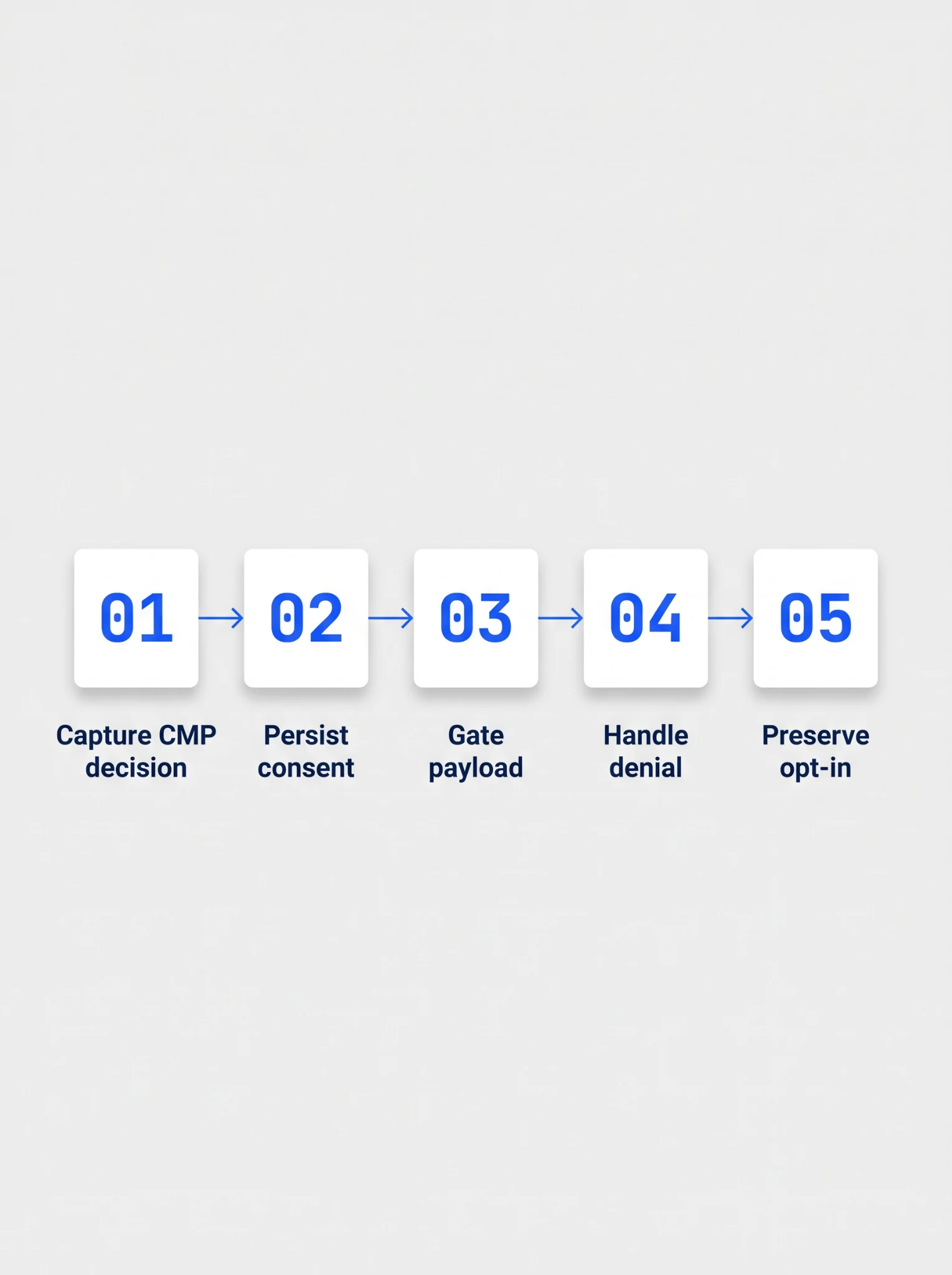
A robust PrestaShop setup synchronizes consent across JavaScript, PHP, and the tracking queue.
Step 1:
Capture the CMP decision in the storefront. When the banner status changes, read the approved marketing purpose and vendor state. If using Consent Mode v2, map active advertising consent to ad_storage=’granted’ and refusal to ‘denied’. Never equate analytics_storage=’granted’ with permission for TikTok ad attribution.
Step 2:
Persist a minimal consent state to the server. Pass the consent state through a controlled endpoint or first-party session mechanism to store it securely in the PrestaShop PHP session. Include a versioned consent status and timestamp; never store raw customer identifiers in the consent cookie.
Step 3:
Gate Events API payload construction. On ViewContent, AddToCart, InitiateCheckout, and Purchase, the server evaluates session consent before assembling payload parameters. With active marketing consent, dispatch event parameters alongside event_id and first-party click attribution. Always ensure you hash user parameters with SHA-256 according to required formatting standards.
Step 4:
Handle denied consent deliberately. The compliant baseline halts marketing event dispatch entirely upon refusal. If your legal framework supports non-profiled measurement, send only permitted non-identifying parameters—never dispatch email hashes, phone hashes, ttclid, cookie IDs, or IP address fields after marketing refusal.
Step 5:
Preserve opted-in attribution. Ensure asynchronous banner updates or fresh sessions do not discard valid permissions. Pass consent state dynamically with each event request, maintain consistent event_id values for deduplication, and retain ttclid in a first-party, consent-gated context for approved visitors.
What breaks when consent is handled incorrectly
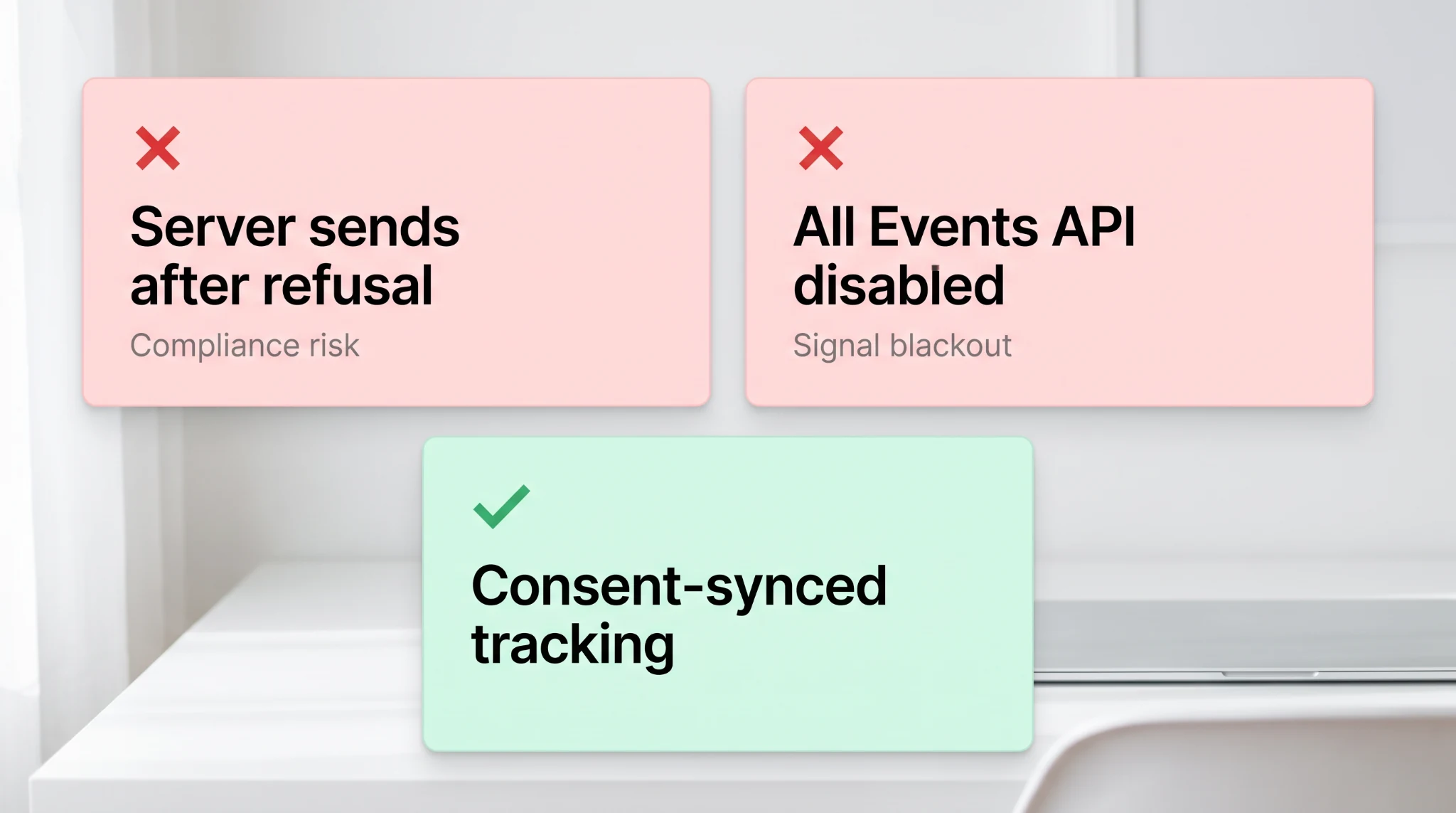
The most dangerous implementation fires server-side purchase events for every customer while merely suppressing the browser pixel. This still transmits protected advertising data after explicit refusal, exposing the merchant to severe GDPR and ePrivacy enforcement penalties.
The opposite failure is equally costly operationally: disabling all Events API traffic for European stores because a fraction of visitors decline. This unnecessarily strips high-value conversion signals from visitors who did consent, drastically lowering Event Match Quality (EMQ), degrading algorithmic campaign optimization, and eroding attributed ROAS.
Pixel Track TikTok for PrestaShop 1.7, 8.0, 8.1, and 8.2 synchronizes supported CMP consent states seamlessly across both browser and server-side pipelines. When marketing cookies are declined, it suppresses the browser pixel and halts non-compliant server payloads according to your store configuration. When consent is granted, fully permissioned conversion data reaches TikTok with the maximum allowed EMQ parameter set.