

A recurring attribution gap affects PrestaShop stores that use offsite payment flows: the PrestaShop back office records a healthy volume of paid orders, while TikTok Ads Manager reports 30–50% fewer Purchase events. The discrepancy is especially visible with PayPal checkout, Stripe 3D Secure, Klarna hosted checkout, and bank-transfer redirects. Because TikTok’s browser pixel commonly fires the Purchase event only after the shopper reaches the store’s order-confirmation page, a successful payment does not automatically trigger a conversion signal.
This creates a misleading performance picture. Revenue and order counts inside PrestaShop may be correct, but TikTok attributes too little revenue to campaigns, ad groups, and creatives. Reported ROAS falls below its true level, profitable campaigns can appear unprofitable, and automated delivery systems receive an incomplete conversion dataset. Smart campaigns and conversion-optimized ad sets may then throttle spend or shift traffic away from audiences that are actually buying.
The inverse problem can occur at the same time: some shoppers who do reach the receipt page reload it, revisit it, or trigger a custom confirmation-page script more than once. Without robust event identity and deduplication, TikTok receives duplicate Purchase events. The result is a tracking implementation that simultaneously loses legitimate paid orders and inflates captured orders—an attribution problem that cannot be diagnosed by comparing total event volume alone.
How Offsite Payment Redirects Break the Purchase Return Path

Offsite payment methods deliberately move the shopper away from the PrestaShop checkout origin. After the customer submits payment, the payment module creates or updates an order, then sends the browser to a PayPal approval page, Klarna-hosted flow, a Stripe 3D Secure challenge, or a bank authentication environment. The customer may complete the financial authorization successfully, but the browser-side TikTok Pixel is not present on third-party domains and cannot fire a Purchase event there. In a conventional PrestaShop implementation, the Purchase script runs only after the shopper lands on order-confirmation.php.
That return journey is not guaranteed. A customer can see a screen stating payment was approved, assume the purchase is complete, and close the tab before the gateway redirects back to the store. They may switch apps, lose connectivity, or encounter a delayed redirect while PrestaShop waits for a callback or webhook. The order becomes valid in PrestaShop server-to-server, yet no confirmation-page load occurs in the original browser. From TikTok’s perspective, the order exists but the client-side Purchase event never happened.
Browser privacy controls make this path less deterministic. Safari Intelligent Tracking Prevention (ITP), in-app browser behavior, and consent choices reduce the persistence of cookies and first-party identifiers across redirects. The TikTok click identifier (ttclid), pixel cookies (_ttp), or session state available during checkout may be lost when the customer returns. Even when the confirmation page loads, the event may contain weaker matching data, reducing TikTok’s ability to connect the purchase to the original ad interaction.
Network and application timing adds another failure mode. The browser may reach the return URL before the payment module finishes validating the transaction or before PrestaShop exposes the order context needed to populate value, currency, content_ids, and a stable order-derived event_id. Conversely, a gateway webhook can validate the order after the shopper has already abandoned the confirmation page. A successful payment callback and a captured browser conversion are separate technical events.
Ghost Conversions: Confirmation-Page Refreshes and Duplicate Purchase Fires

A “ghost conversion” problem emerges when browser behavior, rather than a unique completed order, becomes the trigger for the Purchase tag. The order-confirmation page is a receipt-like endpoint, but it is often implemented as a normal page view containing ttq.track(‘CompletePayment’) or a TikTok Purchase event. If that code executes every time the page renders, one order can generate multiple Purchase requests, creating artificial conversion spikes in TikTok Events Manager.
Common repeat-entry paths are easy to overlook. A shopper may bookmark the confirmation URL, refresh the page, restore the tab after a crash, or use browser back/forward buttons. Custom themes and modules also expose receipt links in emails, account order history, or post-purchase support pages. If these routes reuse the confirmation template without idempotency control, each render emits another client-side event for the same PrestaShop order reference.
The essential control is a stable, order-level event identity. A Purchase should be associated with a deterministic event_id derived from the immutable PrestaShop order ID or reference, rather than a random value generated on page load. TikTok can deduplicate browser and server events only when both payloads carry matching identifiers. A new random event_id on every refresh prevents deduplication and turns repeat receipt views into fake additional purchases.
Diagnosis requires comparing more than aggregate totals. Review TikTok Events Manager for repeated Purchase events sharing the same order value, currency, and content identifiers, then reconcile them against unique PrestaShop order IDs. Inspect network requests on the confirmation page to confirm whether the Purchase call fires on refresh, browser restoration, and receipt-link access. Tie Purchase events to a unique validated order to prevent missing purchases and overstated revenue reporting.
Diagnosing Gateway Drop-Off Versus Order Creation in PrestaShop and TikTok Events Manager
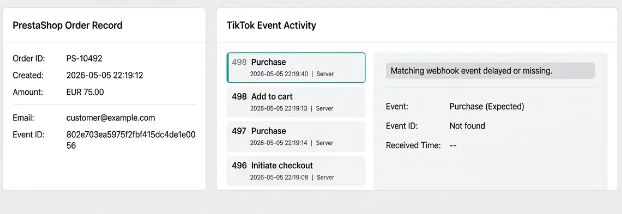
Build the diagnostic around the PrestaShop order record rather than the thank-you-page session. Export ps_orders rows for a fixed attribution window and filter on module IN (‘ps_checkout’, ‘paypal’, ‘stripe_official’, ‘klarnaofficial’). Include id_order, reference, module, payment, current_state, total_paid_tax_incl, and the gateway transaction identifier. Join ps_order_history to establish the validation timeline, and compare validated orders against TikTok Purchase events by timestamp, event_id, value, and currency. Classify each row as: browser Purchase present, server Purchase present, deduplicated Purchase, duplicate browser Purchase, or missing TikTok Purchase.
In TikTok Events Manager, inspect the Purchase detail view rather than aggregate totals. Review Event Quality, event_id consistency, and Deduplication Rate when both Pixel and Events API are enabled. A low deduplication rate indicates distinct event IDs for the same order; high event volume with weak deduplication indicates confirmation-page reloads. Next, inspect event chronology: a pattern where InitiateCheckout is present but Purchase disappears for specific payment modules confirms return-path dependence.
Reproduce the flow in gateway sandbox mode or with a controlled live test. In DevTools Network waterfall, preserve logs across navigation and record the outbound TikTok Pixel request, redirect status chain, gateway URL, return URL, and PrestaShop controller route. Confirm whether the shopper actually reaches order-confirmation, whether the tracking snippet renders, and whether a refresh triggers a second request. Inspect PHP, web server, and PrestaShop logs to correlate requests using order reference, cart ID, and timestamps.
Measure the interval between gateway authorization, Webhook/IPN delivery, PrestaShop order validation, and the browser return. The browser can return before the webhook updates order state, return after it, or never return at all. Delayed webhooks, non-2xx responses, or firewall blocks can produce successful gateway payments with no corresponding validated PrestaShop order. Establish a clear timeline: gateway transaction accepted → notification verified → validateOrder() completed → TikTok Purchase emitted, identifying if emission depended on browser return.
PrestaShop Order Validation Hooks: actionValidateOrder, hookPaymentReturn, and displayOrderConfirmation

displayOrderConfirmation is a presentation hook, not a payment-finality hook. Injecting ttq.track(‘Purchase’) exclusively through displayOrderConfirmation fails when shoppers close the gateway tab, lose connectivity, or encounter third-party modules with custom success routes. It also fails when orders are created via delayed asynchronous notifications. Furthermore, because the confirmation page is reloadable, a presentation-hook-only setup emits duplicate Purchases for single valid orders.
PrestaShop’s backend validation path is independent of frontend rendering. In the standard payment flow, PaymentModule::validateOrder() creates the ps_orders record, assigns the order state, and dispatches actionValidateOrder. Conversely, OrderConfirmationController, hookPaymentReturn, and displayOrderConfirmation execute only when a customer renders the confirmation endpoint. Their execution proves a page was rendered, not that a payment was newly or uniquely confirmed.
With IPN and webhook-driven gateways, the decisive request is a server-to-server callback. The module calls validateOrder() and updates ps_orders without any customer browser request. No Smarty template renders, no displayOrderConfirmation markup generates, and no Pixel JavaScript executes. A robust integration must treat the validated order transition as the primary Purchase trigger, build a stable deterministic event_id, and persist an outbound ledger to block duplicate events from webhook retries.
Placing high-value conversion tracking exclusively in an untrusted client runtime creates architectural risk. Client-side JavaScript can be blocked by ad blockers, privacy controls, script errors, or tab abandonment, and manipulated by page refreshes. The durable design must be server-authoritative: emit Purchase events only after verified payment validation, make delivery idempotent, and use frontend confirmation hooks solely as a secondary, deduplicated signal.
The Resilient Dual-Layer Solution: Authoritative Server Dispatch and Shared Event IDs
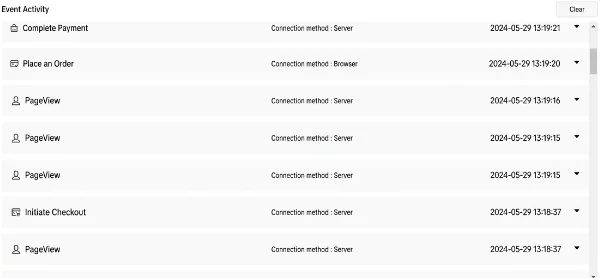
A resilient implementation makes the server—not the thank-you page—the authoritative source of truth. In PrestaShop, actionValidateOrder is the primary lifecycle hook because it executes when the payment module validates the order, regardless of whether the customer returns from PayPal, Klarna, or a card gateway. For asynchronous flows, use the paid-status transition hook. Dispatch must be idempotent: record delivery in a database table keyed by order ID and event name to prevent duplicate signals during retries or status updates.
The browser and server must share identical event identifiers. Generate one deterministic event_id from immutable order data (e.g., order_{id_order}_{order_reference}) and pass it to both TikTok Events API and browser Pixel calls. On successful return, displayOrderConfirmation exposes this exact ID to the client script. Do not use timestamps, random UUIDs, or cart IDs per page render. Alignment across event name, currency, value, content_ids, and event_id ensures deterministic key stability across refreshes and delayed webhooks.
With identical event_id parameters arriving from Pixel and Events API, TikTok’s deduplication logic merges both signals into one conversion. Server dispatch guarantees 100% coverage for non-returning shoppers, while browser events contribute client-side attribution context (_ttp, ttclid, IP, user agent). The result is exactly one counted purchase per validated order: zero lost conversions on skipped thank-you pages and zero inflated ROAS from reloaded receipts.
Pixel Track TikTok implements this dual-layer pattern natively for PrestaShop 1.7 through 8.2. Its turnkey browser and server-side tracking uses shared order-derived event_id keys for deduplicated delivery across all five core events. By pairing browser events with authoritative server dispatch, it provides a production-ready fix for payment gateway redirects and asynchronous order validations without custom code maintenance.
Conclusion: Fix Attribution Before Scaling TikTok Ad Spend

Payment attribution breaks when Purchase events depend on shoppers completing a return trip from an offsite gateway to order-confirmation. Successful PayPal, Klarna, or card payments validate PrestaShop orders even if customers close the tab or lose connection. In these cases, real revenue exists in PrestaShop, but browser-only TikTok Purchase tracking fails completely.
The corrective architecture treats PrestaShop order validation as the authoritative conversion boundary and dispatches Purchase events server-side with a stable identity. When browser confirmation loads, it must share the exact same event_id for deduplication, preserving client match context without inflating ROAS or double-counting orders.
Do not scale TikTok ad spend against incomplete purchase signals. Install Pixel Track TikTok at https://pixeltracktiktok.com/ to deploy dual browser-plus-server tracking, shared event IDs, and full parameter handling before making budget allocation decisions.